
 Interior Design Hyderabad
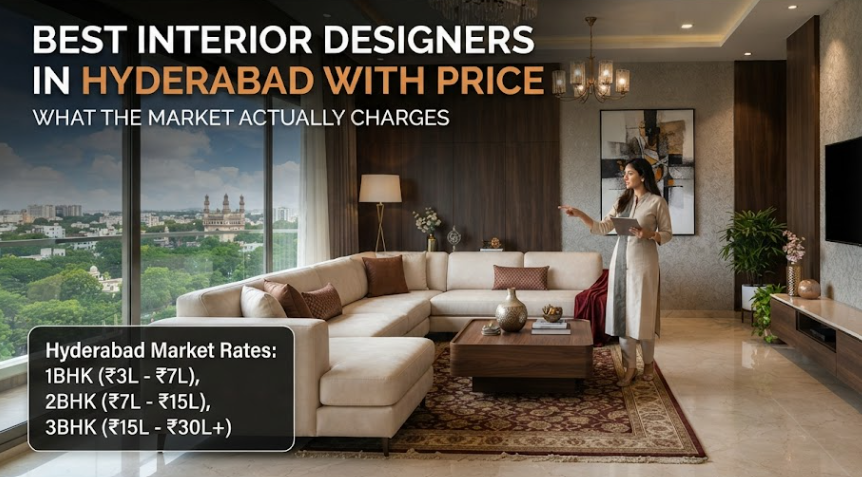
Best Interior Designers in Hyderabad With Price: What the Market Actually Charges (Updated August 2026)
By Interiorji Trends Team • August 20, 2026
Search "best interior designers in Hyderabad with price" and you'll find a dozen "top 10" lists — and not one of them shows you an actual number next to an actual name, because interior design pricing isn't published like a menu. It's quoted per project, and most studios simply don't disclose rates publicly. So instead of another list padding out ten names with no verifiable pricing attached, this guide does the research a "with price" search actually wants: what the published, checkable pricing models in Hyderabad's market look like right now, across budget, mid-range, and premium tiers, so you can walk into any consultation — ours or anyone else's — already knowing what a fair number should look like.
The Four Pricing Models You'll Actually Be Quoted
Before any specific numbers, it helps to know that "price" in this industry isn't one thing — firms quote against four distinct models, and comparing a number from one model against a number from another is where most of the confusion in "best interior designer with price" searches actually comes from.
- Per-square-foot rate: The most common model for full-home interiors. Hyderabad's market currently runs roughly ₹1,200 to ₹3,500 per sq ft depending on finish tier, with turnkey-scope quotes from larger national platforms sometimes extending up to ₹12,000 per sq ft at the most premium, fully custom end.
- Flat-fee packages: A single bundled number for design and execution together, typically running roughly ₹6 lakh to ₹40 lakh depending on home size and scope — the width of that range is exactly why "flat fee" numbers alone are close to meaningless without knowing what's inside them.
- Percentage of project cost: Some designers, more common at the premium and luxury end, charge roughly 15-25% of total material and labour cost as a design fee layered on top of execution.
- Hourly or consultation-only: For design advice without execution — increasingly offered as a standalone option — rates run roughly ₹1,300 to ₹5,000 per hour, or a flat consultation package that can start around ₹50,000 for a full advisory engagement without any execution attached.
Any "with price" comparison that doesn't first tell you which of these four models a number belongs to isn't actually comparable to anything.
What a Full Home Interior Actually Costs in Hyderabad Right Now, By Tier
Based on currently published pricing from major national interior platforms operating in Hyderabad, a fully furnished apartment interior — kitchen, wardrobes, and core carpentry — typically lands in the ₹5 lakh to ₹15 lakh range for a standard 2BHK or 3BHK, with the spread driven almost entirely by finish tier rather than home size alone:
| Tier | Per Sq Ft Rate | 2BHK Full-Home Range |
|---|---|---|
| Budget (laminates, essential storage) | ₹1,200 – ₹1,800 | ₹5L – ₹7L |
| Mid-range (better laminates, custom wardrobes, designer lighting) | ₹1,800 – ₹2,600 | ₹7L – ₹10L |
| Premium (PU/veneer, imported finishes, smart storage) | ₹2,600 – ₹3,500+ | ₹10L – ₹14L+ |
These figures track closely with what our own 2BHK cost breakdown and 3BHK cost breakdown show for room-wise pricing — which is a useful sanity check in itself. When independently researched market data and our own room-wise breakdown land in the same range, that's a reasonable sign the numbers are grounded in what's actually being charged, not an inflated or deflated estimate either direction.
A Late-Monsoon Note on Timing (August-September)
One thing worth factoring into a quote you get this specific month: material logistics, particularly imported hardware and certain veneer stocks, can see minor lead-time slippage through the tail end of Hyderabad's monsoon season, which occasionally nudges premium-tier quotes up slightly or extends stated delivery windows by a week or two. It's not a large effect and it doesn't change the tier ranges above, but if a quote you're comparing was generated in June and another in late August, don't assume a small difference between them reflects a change in the provider's pricing — ask whether it reflects a seasonal materials note instead.
What "All-Inclusive" Should Actually Mean at Any Price Point
One thing worth taking from how the larger, more transparent national platforms structure their pricing: a properly quoted number should already include design consultation, 3D previews, designer fees, hardware, manufacturing, and installation — with no separate hidden design fee layered on afterward. If a quote you're comparing doesn't specify this explicitly, that's the first thing to ask about before comparing its bottom line against anyone else's. This is also where a lot of "cheap" quotes turn out not to be cheaper at all once the excluded costs get added back in.
GST is worth calling out specifically here, since it's the single most common gap between two quotes that otherwise look identical: confirm directly whether the number you've been given is inclusive or exclusive of 18% GST before comparing it to anything else. A quote that looks 15-18% cheaper than another is sometimes simply quoting pre-tax while the other quotes post-tax — not actually a better price.
Where the Real Price Variation Comes From (It's Not Home Size)
Across every source we reviewed, the same pattern holds: material grade and finish choice move the price far more than square footage does. A modest 2BHK with premium PU-finish carpentry throughout can cost more than a larger 3BHK finished entirely in laminate. If you're trying to estimate your own project's likely cost, start from your target finish tier, not your home's size — size mainly tells you how much carpentry surface you're paying that per-sq-ft rate against, but the rate itself is set by material choice.
Design Fee vs Percentage Model: Which Actually Costs More
For a mid-size 2BHK project around ₹8 lakh in execution cost, a percentage-based design fee at 15-25% adds roughly ₹1.2 lakh to ₹2 lakh on top — which is often comparable to or higher than an all-inclusive flat quote covering the same scope. This isn't a reason to avoid percentage-based pricing outright — some homeowners prefer it because the fee scales transparently with project complexity — but it's worth actually running the comparison rather than assuming either model is inherently cheaper. Our luxury vs budget interior designers guide walks through this comparison in more depth for homeowners weighing tier and fee structure together.
Budget Interior Designers: What "Budget" Actually Buys at Current Rates
At the ₹1,200-1,800 per sq ft end of the market, expect laminate finishes throughout, standard hardware, and essential storage — a fully functional home, but with less customisation and a narrower material palette than mid-range or premium packages. This isn't a lesser version of a "real" interior; for homeowners who know what they want and don't need extensive design exploration, it's a legitimate and cost-efficient choice, not just a compromise. Where budget quotes most often disappoint is when the excluded scope — civil work, electrical modification, false ceiling — isn't disclosed upfront and gets added back as a surprise mid-project.
National Modular Platforms vs Local Hyderabad Studios: What the Price Actually Buys
Part of what "best interior designers in Hyderabad with price" searches are really trying to figure out is whether a large national platform or a local studio is the better value at a given price point — and the honest answer is that they're often not competing on price so much as on what's included at that price.
Large national modular platforms typically compete on pricing transparency and process — itemised quotes, real-time cost visibility during 3D design, milestone-based payments, and 10-year warranties on modular components are increasingly standard at this end of the market. What they're generally less flexible on is deep customisation outside their modular catalogue — a fully bespoke layout or an unusual material request can push you outside their standard pricing tiers quickly, or may not be offered at all.
Local Hyderabad studios and design companies, by contrast, generally offer more layout and material flexibility for a comparable price band, but the pricing transparency varies far more studio to studio — some are just as itemised and clear as the national platforms, others still work off vaguer lump-sum quotes that need to be pushed on directly. This is exactly why the pricing-model questions earlier in this guide matter more when you're evaluating a local studio than when you're evaluating a platform with a standardised, published process.
Neither category is categorically better value — a homeowner who wants a fully custom pooja room or an unusual layout is often better served locally even at a similar or slightly higher price; a homeowner who wants a fast, standardised, transparently-tracked process may prefer the platform model even with less customisation. The useful question isn't "which is cheaper" but "which is offering more of what I actually need at this price."
How to Use These Numbers When You Get Your Own Quote
- Identify which of the four pricing models you're being quoted against before comparing the number to anything else
- Ask whether the quote is all-inclusive (design fee, hardware, installation bundled) or has costs layered on separately
- Confirm whether the number is GST-inclusive or exclusive before comparing it to any other quote
- Check the quoted per-sq-ft rate against the tier table above — a number well outside these ranges either direction deserves a specific explanation, not just acceptance
- Run the actual math on percentage-based fees against your expected execution cost before assuming they're cheaper than a flat quote
- Confirm what's excluded — civil work, electrical, false ceiling — explicitly, in writing, before comparing bottom-line totals
For the fuller checklist of what any written proposal should include beyond price alone, see our interior designer selection guide, and if you want to sanity-check a firm's transparency claims specifically before trusting their number, our guide to evaluating tracking systems and reviews covers that separately.
Where Interiorji Sits in This Market
We quote against the same market reality reflected above — itemised by room and material, GST clearly stated, with design consultation, hardware, and installation bundled into the number you see, not layered on afterward. Rather than positioning ourselves as the cheapest option in the city, our aim is that our number is fully explained before you commit to it: which tier it reflects, what's included, and what would change it. For a full room-wise breakdown of what drives your specific number, our complete Hyderabad interior cost guide covers every room category in detail.
Frequently Asked Questions
Why don't more interior designers publish their prices online?
Because actual cost depends on so many project-specific variables — home layout, material choice, site conditions — that a single published number would be misleading for most homeowners' actual projects. The per-sq-ft and tier ranges above are a more honest starting point than any single flat number a website could publish.
Is a lower per-sq-ft rate always a better deal?
Not necessarily — check what's excluded first, and whether it's GST-inclusive. A lower headline rate that excludes civil work, electrical modification, design fees, or tax can end up costing more once those are added back than a slightly higher all-inclusive quote.
How much should a budget interior designer in Hyderabad charge for a 2BHK?
Based on current market rates, a genuinely budget-tier full 2BHK interior — laminate finishes, essential storage — should land roughly in the ₹5-7 lakh range. Significantly below that typically means reduced scope (fewer wardrobes, no false ceiling) rather than the same scope at a lower price.
Is percentage-based pricing or flat-fee pricing better for a first-time homeowner?
Flat-fee, all-inclusive pricing is generally easier for a first-time homeowner to budget against, since the number doesn't shift as material choices are finalised. Percentage-based pricing can work well if you value fee transparency as costs evolve, but it requires more active tracking on your end.
Want a fully itemised quote for your specific home rather than a market range? Get a free estimate and we'll break it down by room and material before you commit to anything.