
 Interior Design Hyderabad
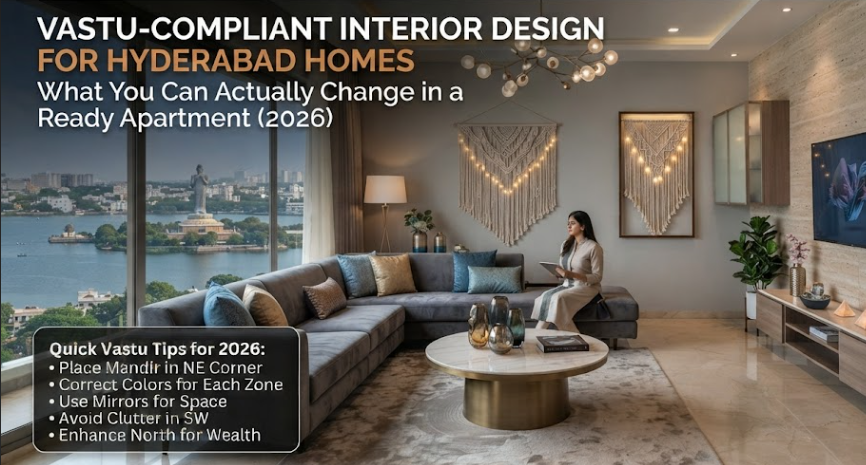
Vastu-Compliant Interior Design for Hyderabad Homes: What You Can Actually Change in a Ready Apartment (2026)
By Interiorji Trends Team • August 18, 2026
Most vastu content assumes you're building a house from the ground up — pick the plot orientation, place the kitchen in the southeast, put the main door on the north wall. That's not much use if you've already bought a 2BHK in a Gachibowli high-rise with the kitchen fixed in the northwest and no way to move a single load-bearing wall. The real question most Hyderabad homeowners are actually asking isn't "how do I build a vastu home" — it's "how much of this can I still achieve through interiors alone, in a layout I can't change." That's what this guide actually answers.
What Interiors Can Fix, and What They Genuinely Can't
Before any room-by-room detail, it's worth being direct about the limits. Vastu shastra traditionally assigns directions to structural elements — the position of the main door, the plot's overall orientation, where load-bearing walls sit. Interior design cannot move a door, relocate a kitchen to a different corner of the flat, or change which direction your bedroom window faces. If a strict, structurally complete vastu compliance is the goal, that's a conversation to have before buying a home, not after.
What interior design genuinely can influence, even within a fixed layout: furniture placement and orientation, storage and wardrobe positioning, color palette, lighting design, mirror placement, and the position of movable elements like the pooja unit, study table, or bed within a room. For the vast majority of apartment owners working within an already-built structure, this is where the real, achievable impact lives — and it's worth treating that as a legitimate goal in itself rather than a lesser compromise.
Living Room: Furniture Orientation Over Room Direction
Traditional vastu favors a living room in the north or east of the home, but if yours sits elsewhere, seating orientation is the lever actually available to you. Position the main seating so it faces east or north where possible, since this is considered to support better energy flow for the household's primary gathering space. Keep the center of the living area — and ideally the home's overall center — as open and uncluttered as possible; this is one of the more universally cited principles across vastu guidance and also happens to be good general design practice, since an overcrowded central zone makes any room feel smaller than it is.
For lighting, prioritize maximizing natural light through your existing windows rather than assuming you need structural changes — sheer curtains instead of heavy blackout drapes, and warm ambient lighting layered rather than a single harsh overhead fixture, both align with vastu guidance on avoiding dim, closed-off living spaces.
Kitchen: Working Within a Fixed Position
The traditional vastu-ideal kitchen position is the southeast corner of the home. If your apartment's kitchen sits elsewhere — extremely common in Hyderabad's newer high-rises, where kitchen placement is dictated by plumbing stacks shared across floors — you're not able to relocate it, but you can still influence the internal layout meaningfully. Within the existing kitchen footprint, positioning the stove or cooktop toward the southeast or east side of the room, with the cook facing east while working, is a commonly followed adjustment that doesn't require moving plumbing or gas lines. Keep water-based fixtures — sink, wash area — toward the northeast or north side of the kitchen where your layout allows, creating a practical separation between the fire and water zones within the space you actually have.
If you're planning a modular kitchen redesign regardless of vastu considerations, this is worth raising with your designer at the layout stage — repositioning the stove relative to the sink within a U-shaped or parallel modular layout is a minor design decision if it's planned upfront, and a much bigger one if it's requested after cabinetry is already fabricated.
Master Bedroom: The Adjustments That Don't Require Structural Change
Vastu traditionally favors the master bedroom in the southwest of the home — again, not something interiors can relocate. Within whichever room you have, bed placement is the most impactful adjustment actually available: position the bed so the headboard is against the south or west wall, allowing you to sleep with your head toward the south, which is the most commonly cited sleeping direction in vastu guidance for rest and stability. Avoid positioning the bed directly under an exposed beam or in direct line with the bedroom door if the room's dimensions allow an alternative placement.
Wardrobe placement in the southwest corner of the bedroom is a common recommendation, and this is genuinely easy to influence during a custom wardrobe design — a designer working with vastu awareness can adjust the wardrobe's position within the room layout during the design phase rather than treating it as an afterthought once the carpentry is already planned.
Pooja Room or Pooja Unit: The Easiest Element to Actually Get Right
Unlike a kitchen or bedroom, a pooja room or dedicated pooja unit is one of the few elements in a modern apartment that's genuinely movable within your interior design, since it's typically a standalone piece of carpentry rather than a plumbed or structurally fixed room. The northeast direction is the most widely recommended placement for a pooja space, and if your apartment layout allows a northeast-facing corner in any room — even a compact one — that's usually achievable through the interior design plan rather than requiring any structural change. If a full northeast placement genuinely isn't possible given your layout, east is generally considered the next-best alternative. Our 3BHK interior cost guide covers what a dedicated pooja room or unit typically costs to build well, separate from the rest of your carpentry budget.
Colors, Mirrors, and Materials: The Low-Cost, High-Flexibility Layer
Color palette is one of the easiest vastu-aligned adjustments to make regardless of your layout, since it requires no structural change at all. Lighter, calming shades — soft blues, greens, creams — are commonly recommended over dark, heavy tones, particularly in bedrooms and living spaces. Reds and blacks are generally advised against as dominant wall colors in vastu guidance, though small accents are usually considered fine.
Mirror placement is worth specific attention: avoid placing a mirror directly facing the bed in a bedroom, which is a commonly cited adjustment, and consider mirror placement in the living or dining area instead, where it's more commonly recommended to reflect light and space. Material choices favor natural elements — wood, stone, and earthen tones — over predominantly synthetic or reflective heavy surfaces, which aligns reasonably well with current design trends toward warm, natural materials regardless of vastu considerations specifically.
Main Door and Entrance: What's Actually Adjustable Post-Purchase
The entrance direction itself is fixed once you've bought the flat, but the area immediately around your main door is one of the more overlooked spaces where interior treatment genuinely matters in vastu guidance, since it's considered the primary point where energy enters the home. Keep the entryway well-lit, uncluttered, and free of large obstructions like oversized shoe racks or storage units directly opposite the door — this is both a commonly cited vastu adjustment and, independently, good practical design for a small entry foyer that tends to become a dumping ground for footwear and bags otherwise.
If your main door doesn't face an ideal direction, some homeowners work with a vastu consultant on remedial measures such as specific door colors, a threshold design, or placement of auspicious symbols near the entrance — these are treated as partial adjustments rather than a full substitute for door orientation, and it's worth discussing with a consultant directly rather than assuming any single design element fully resolves a structural placement issue.
Flooring and Ceiling: Minor Adjustments Within a Fixed Structure
Flooring material is one of the few structural-adjacent elements you can actually change without construction-level work, since it's typically replaced during a full interior renovation regardless of vastu considerations. Vastu guidance generally favors natural materials — stone, tile, or wood — over synthetic flooring, and advises against extreme flooring color choices in bedrooms specifically. If you're already planning to redo flooring as part of a broader interior project, this is a reasonable point to factor in alongside your material and budget decisions rather than treating it as a separate consideration.
For false ceilings, vastu guidance generally favors flatter, simpler ceiling treatments over heavily layered or excessively elevated designs, particularly in bedrooms. This doesn't rule out a false ceiling entirely — most Hyderabad apartments benefit from at least a simple perimeter treatment for lighting and finish — but it's worth keeping bedroom ceiling designs relatively restrained if vastu alignment is a priority for that room specifically, while allowing more design flexibility in the living room and other common areas.
A Practical Way to Approach This With Your Designer
If vastu compliance matters to you, the most efficient way to get it right is raising it at the very first design consultation, before layouts or 3D concepts are finalised — not as an afterthought once carpentry drawings are already approved. Bring a simple list of your non-negotiables (bed direction, pooja room placement, kitchen stove orientation if it's adjustable within your existing layout) the same way you would with any other design requirement, and ask your designer to work these into the space planning phase directly. Retrofitting vastu adjustments after a design is finalised is possible in some cases but often means compromises that could have been avoided with earlier planning.
It's also worth being realistic with yourself about which adjustments matter most to you specifically, since a strict full-compliance approach across every single room can meaningfully constrain layout and storage efficiency in a compact apartment. Most homeowners we work with prioritize two or three elements — often bed direction, pooja room placement, and main door area treatment — rather than pursuing full compliance across every guideline, which tends to be a more practical balance in a fixed apartment layout.
Frequently Asked Questions
Can an interior designer make a non-vastu-compliant apartment fully vastu-compliant?
Not fully, if the non-compliance involves structural elements like door position, kitchen location, or room orientation — those require construction changes, not interior design. What a designer can do is work within the fixed structure to align furniture placement, colors, storage, and movable fixtures as closely as possible to vastu principles.
Is it worth hiring a separate vastu consultant alongside an interior designer?
For homeowners who want detailed, personalized guidance beyond general principles, yes — a vastu consultant can review your specific floor plan and provide room-by-room recommendations, which your interior designer can then incorporate into the actual design and carpentry plan.
Does following vastu principles increase interior design costs?
Generally not significantly, if it's planned from the start of the design phase — most adjustments are about furniture placement, orientation, and layout decisions rather than additional materials or construction. Costs can increase if vastu adjustments are requested after carpentry has already been fabricated and needs to be reworked.
What if my apartment's kitchen or main door position genuinely can't be reconciled with vastu at all?
This is common in high-rise apartments with fixed plumbing and door placements set at construction. Many vastu consultants and homeowners treat certain remedial measures — specific color choices, mirror placement, or small design elements — as partial mitigations in these cases, though it's worth setting realistic expectations that these aren't a full substitute for structural compliance.
Planning a vastu-conscious interior for your Hyderabad home? Get a free estimate and mention your priorities upfront — we'll factor them into the space planning from day one rather than as an afterthought.